Airway management in the UK is changing. The updated 2025 Difficult Airway Society (DAS) guidance recommends video-laryngoscopy as part of routine airway management, rather than solely a rescue technique or a device reserved for predicted difficulty. At the same time, the Department of Health and Social Care’s Design for Life Roadmap has set out an ambition for a more circular economy, prioritising a move away from single-use medical technologies where safe and feasible — and video-laryngoscopes have been identified as a high-priority area for transition towards reuse.
Taken together, these developments create an important challenge for anaesthetic departments: how can increasing adoption of video-laryngoscopy be delivered in a way that is financially viable, environmentally sustainable and logistically practical? This is the challenge Freeman Hospital, Newcastle, set out to address.
The burden of single-use laryngoscopes
Within the UK, approximately one million tracheal intubations are performed annually, based on data from the NAP7 study. To support this activity, NHS England procured approximately 1.22 million laryngoscopes and handles (direct and video) in 2024/25 at a total cost of £8.56 million. Direct laryngoscopy accounted for 60% of purchases, with video-laryngoscopes representing the remaining 40%. Only around 2,600 devices (0.21%) were reusable — 1.21 million (99.7%) were single use.
Single-use laryngoscopes are not only financially costly but also environmentally burdensome. Compared with reusable devices undergoing sterilisation or high-level disinfection, single-use steel blades produce 7.5 times more greenhouse gas emissions (GHGe) per use, while single-use handles generate 24–27 times more GHGe. Given that laryngoscopes are typically used for only seconds before being discarded — often via clinical waste incineration — the continued reliance on single-use devices is increasingly difficult to justify when safe and sustainable reusable alternatives exist.
What level of decontamination do laryngoscopes require?
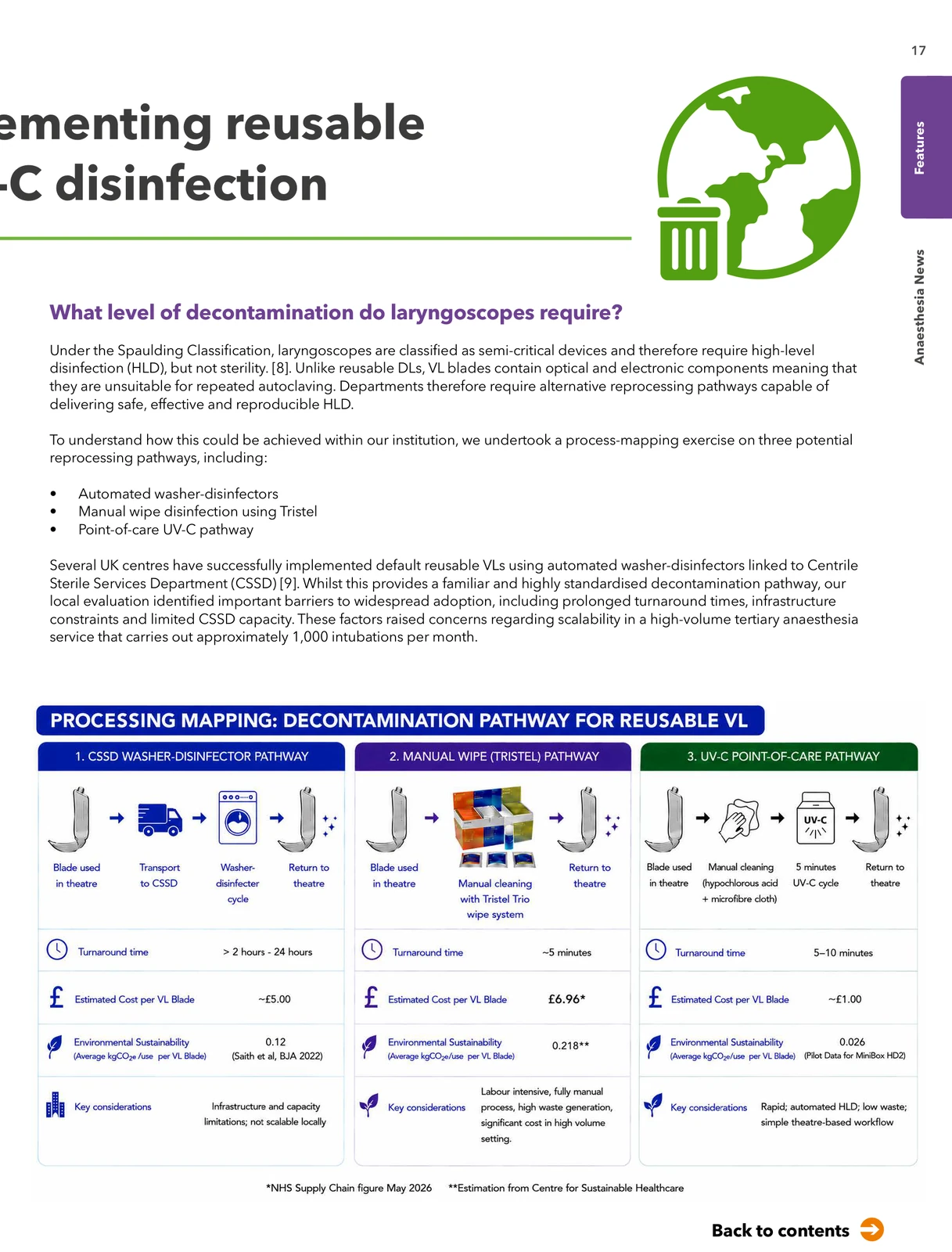
Under the Spaulding Classification, laryngoscopes are classified as semi-critical devices and therefore require high-level disinfection (HLD), but not sterility. Unlike reusable direct laryngoscopes, video-laryngoscope blades contain optical and electronic components, meaning they are unsuitable for repeated autoclaving. Departments therefore require alternative reprocessing pathways capable of delivering safe, effective and reproducible HLD. To understand how this could be achieved, the team undertook a process-mapping exercise across three potential reprocessing pathways.
Comparing three decontamination pathways
CSSD Washer-Disinfector
Source: Saith et al., BJA 2022
Infrastructure and capacity limitations; not scalable locally.
Manual Wipe (Tristel)
Source: Estimation, Centre for Sustainable Healthcare
Labour intensive, fully manual process, high waste generation, significant cost at high volume.
UV-C Point-of-Care
Source: Pilot data, Minibox-HD2
Rapid, automated HLD, low waste, simple theatre-based workflow.
Figures as reported in the original study; cost and turnaround estimates are illustrative to the authors’ institution and reprocessing volumes, and will vary by site.
Several UK centres have successfully implemented default reusable video-laryngoscopes using automated washer-disinfectors linked to a Central Sterile Services Department (CSSD). While this provides a familiar and highly standardised decontamination pathway, the team’s local evaluation identified important barriers to widespread adoption, including prolonged turnaround times, infrastructure constraints and limited CSSD capacity — concerns in a high-volume tertiary anaesthesia service carrying out approximately 1,000 intubations per month.
Point-of-care decontamination using UV-C technology
Recognising the limitations of both CSSD-based washer disinfection and fully manual wipe systems, the team explored whether a point-of-care UV-C disinfection pathway could provide a more scalable solution for reusable video-laryngoscopes. UV-C offered several potential advantages, including rapid turnaround times, reduced waste, lower operational burden and a simplified theatre-based workflow. The technology was already familiar within the organisation through its use for transoesophageal echocardiography probe reprocessing, and is increasingly being adopted for other semi-critical devices, including flexible nasendoscopes, anaesthetic facemasks and laryngoscope handles.
ENT UK has endorsed UV-C for flexible nasendoscope reprocessing, citing major reductions in energy use, processing time and waste; evidence also suggests UV-C is non-inferior to conventional HLD methods, including automated washer-disinfectors, for semi-critical, non-channelled devices. Working with the Infection Prevention and Control (IPC) team and Trust Decontamination Group, Freeman Hospital developed a standard operating procedure (SOP) for reusable C-MAC video-laryngoscope reprocessing using a Minibox-HD2 UV-C system. Approval of the SOP required robust microbiological validation: Mackwell Health provided laboratory testing specific to the C-MAC blades, alongside commissioning independent laboratory evaluation of the reprocessing workflow.
To evaluate the pathway, the team undertook a four-month pilot across three ENT theatres. Reusable C-MAC video-laryngoscopes were introduced into routine clinical practice, supported by a single illuvi® HD2 unit capable of reprocessing two blades per five-minute cycle. During the pilot, video-laryngoscope use increased from 12% to 90%, enabling assessment of the pathway under conditions representative of a default VL model.
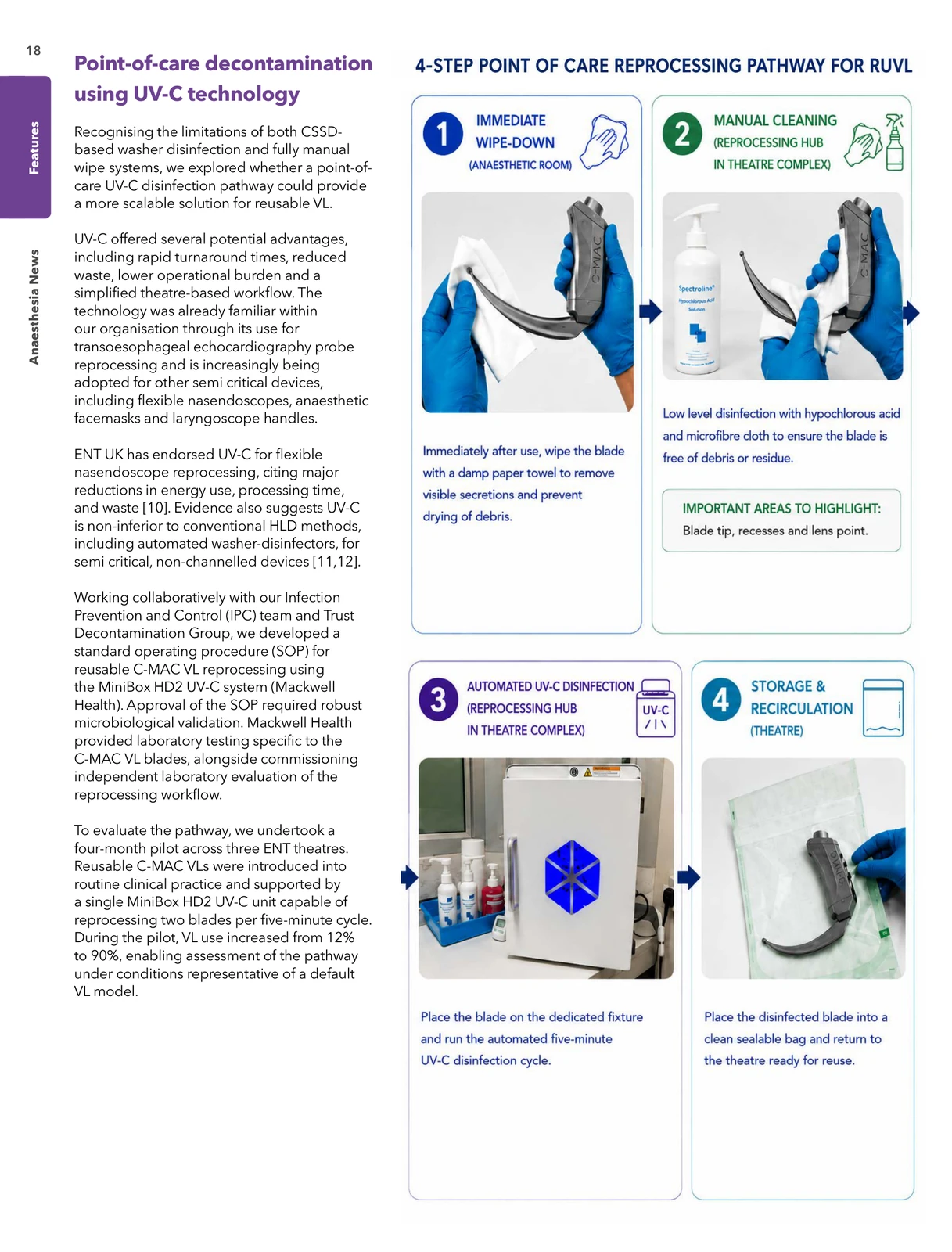
The 4-step point-of-care reprocessing pathway
Immediate wipe-down
Anaesthetic roomImmediately after use, the blade is wiped with a damp paper towel to remove visible secretions and prevent debris from drying — with particular attention to the blade tip, recesses and lens point.
Manual cleaning
Reprocessing hub, theatre complexLow-level disinfection using a hypochlorous acid solution and microfibre cloth ensures the blade is free of debris or residue ahead of high-level disinfection.
Automated UV-C disinfection
Reprocessing hub, theatre complexThe blade is placed on a dedicated fixture inside the illuvi® HD2 unit and an automated five-minute UV-C disinfection cycle is run.
Storage & recirculation
TheatreThe disinfected blade is placed into a clean, sealable bag and returned to theatre, ready for reuse.
Reprocessing steps as implemented in the Freeman Hospital pilot; specific SOP details are subject to each institution’s own IPC and decontamination governance and will vary by device and site.
Making friends with IPC
A recurring challenge throughout this work was balancing competing priorities in patient safety and infection prevention against practical implementation. There remains considerable variation in decontamination requirements between organisations, with no clear national consensus on appropriate reprocessing pathways for reusable airway equipment. In response, the team agreed a 72-hour storage period for clean, unused blades with the IPC team — a pragmatic compromise that satisfied infection prevention requirements without creating unnecessary reprocessing workload.
Perhaps the most important lesson from the pilot was the value of engaging with IPC and the Trust Decontamination Group at an early stage — working collaboratively to create a reprocessing workflow that prioritised patient safety while remaining practical, efficient and achievable within the infrastructure of the department.
Conclusion
Airway management is in a period of significant change. The growing evidence base supporting video-laryngoscopy, together with the updated DAS guidance, means departments not currently practising default video-laryngoscopy will inevitably move in this direction over the coming years. Reusable video-laryngoscopy represents a rare opportunity to align these ambitions with improvements in patient safety and sustainable airway equipment. Rather than viewing sustainability and clinical excellence as competing priorities, this project demonstrates that they can be pursued simultaneously. The question may no longer be whether departments should adopt reusable video-laryngoscopy, but how quickly they can implement systems that make routine, sustainable use possible.
The Karl Storz C-MAC video-laryngoscopes used during the pilot were provided as a temporary research loan at no cost to Newcastle Hospitals NHS Foundation Trust.
The Minibox-HD2 UV-C disinfection unit (Mackwell Health) was supplied under the company’s standard commercial rental agreement.
References
- Ahmad I, El-Boghdadly K, Iliff H, Dua G, Higgs A, Huntington M, et al. Difficult Airway Society 2025 guidelines for management of unanticipated difficult tracheal intubation in adults. British Journal of Anaesthesia 2026;136(1):283–307.
- Department of Health and Social Care. Design for Life Roadmap: Building a Circular Economy for Medical Technology. 2025. London: DHSC.
- Centre for Sustainable Healthcare. Transition to Reusable Medical Technology, 2025.
- Royal College of Anaesthetists. NAP7: At the Heart of the Matter — The 7th National Audit Project of the Royal College of Anaesthetists, 2025.
- NHS England. Laryngoscope procurement data, financial year 2024/25. Unpublished procurement data provided by NHS England, May 2026.
- Saith JD, Railsby LA IV, Eckelman MJ. Life cycle assessment and costing methods for device processing: comparing reusable and single-use disposable laryngoscopes. Anaesthesia & Analgesia 2018;127(2):434–443.
- Mallick T, Verma A, Jaiswal S, Haldar M, Sheikh WR, Vishen A, et al. Comparison of the time to successful endotracheal intubation using the Macintosh laryngoscope or KingVision video laryngoscope in the emergency department: a prospective observational study. Turkish Journal of Emergency Medicine 2020;20(1):22–27.
- Rutala WA, Weber DJ. Reprocessing semicritical items: Outbreaks and current issues. American Journal of Infection Control 2019;47S:A79–A89.
- Kelly FE, Scholz A, Mayer J, Groom P, McGuire B, Cook TM. Implementation of default video-laryngoscopy instead of direct laryngoscopy for tracheal intubation: a narrative review of evidence and experiences. Anaesthesia 2025.
- ENT UK. Environmental Sustainability Guidance: Flexible Nasendoscopes. London: ENT UK; 2023.
- Halmans Y, Wellenstein D, Hopman J, Takes R, van den Broek G. Is UV-C light disinfection suitable as a disinfection method for medical devices: a scoping review. Antimicrobial Resistance and Infection Control 2026;15:2.
- Halmans Y, Wellenstein DJ, Romijn M, Cremers S, Smit JJ, Hopman J, et al. Is ultraviolet light disinfection fit to be the future standard for the disinfection of flexible endoscopes without a working channel? Clinical Otolaryngology 2023;48(6):1094–1101.